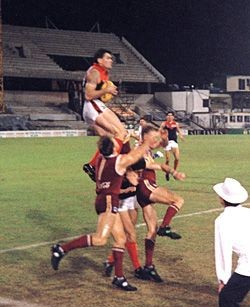
Shaun Smith, ex-North Melbourne and Melbourne AFL player best known for taking the ‘Mark of the Century’ against the Brisbane Bears at the Gabba in 1995, played over 100 games for North Melbourne and Melbourne in the 80s and 90s. However, post-retirement, Shaun began experiencing symptoms associated with Chronic Traumatic Encephalopathy (CTE) – a degenerative brain disease caused by repeated head trauma.
Known for his courageous playing style and spectacular high-flying marks, Shaun suffered numerous head knocks throughout his career. A magnetoencephalography (MEG) scan later revealed significant damage to his frontal lobe, the region of the brain responsible for behaviour and decision-making. Shaun hasn’t worked since 2019.
Over time, Shaun has openly shared how he has struggled with severe mood swings and flashes of irrational anger. He described these periods as going from ‘zero to nuclear’ in seconds. As he recounts: ‘There were days I didn’t want to get out of bed, and nights where I thought it would be better if I didn’t wake up. I’d look in the mirror and not recognise the person staring back at me. It was like I was losing myself piece by piece.’ He says these profound behavioural changes contributed to the breakdown of his marriage, episodes of homelessness, and legal difficulties – a stark contrast to his celebrated career on the field.
At his worst, he claims he drank a slab and never wanted to wake up. Thankfully, he had someone in his life who said, ‘Enough! Enough of this rubbish.’ She made some calls and helped get him admitted to the Melbourne Clinic, where he was given psychiatric support and ‘a lot of medication’.
As he explains: ‘I was there for three months. I was pretty ashamed about it at the time and felt like I had failed, but looking back it was the best thing I ever did. It helped me to escape reality and just focus on myself. The other patients in there were actually great sources of inspiration as well. Jaw-dropping stuff, some of the stories I heard.’
He continues: ‘One thing I can say to anyone who might be struggling is just go and get some help and don’t bullshit – be honest with yourself about where you’re actually at. Many people will tell a doctor they’re fine but it’s just lies. That was the stepping stone for me, going there. There’s an image I have in my head of my kids coming into my room – they were both so distraught at seeing dad in “the loony bin”. That’s been a driver for me, just seeing that image in my head – that was the moment I said, “Pull your head in, Shaun. Let’s do this for my kids.”
The other major change that he credits for dramatically improving his situation has been to give up drinking. He is the first to admit that ‘That’s been the big one.’
Today, Shaun is a passionate advocate for concussion awareness in contact sports. His personal journey highlights the long-term risks faced by athletes and underscores the urgent need for improved concussion protocols and robust support systems. While CTE can currently only be definitively diagnosed post-mortem, Smith’s story is a powerful addition to the growing evidence linking high-impact sports to serious neurological conditions.
While he still enjoys watching his kids play footy (his son is former Melbourne and North Melbourne player Joel Smith and his daughter Amy won a Premiership in the AFLW with North Melbourne in 2024), he has serious concerns around the risks associated with playing such a high-contact sport. In particular, he is uneasy about the AFL’s one-size-fits-all 12-day return-to-play protocol. As he says, ‘These players are coming back within 12 days, which equates to one game out – they’re coming back playing with a brain injury. The symptoms may be gone after a week but you still have a brain injury. Talk to Alan Pierce about it – he’s saying it’s 26–28 days and that’s a minimum.’
Dr Alan Pierce, a neuroscientist and concussion expert, supports extended stand-down periods, emphasising that prolonged exposure to repetitive head impacts is a significant risk factor for neurodegenerative disease.
Smith explains how he has been pleased to see Garry Lyon using stronger language in the media around players coming back to play with what he described as ‘a brain injury’. ‘He wasn’t dismissing it – concussion is not just a head knock. It is a brain injury.’
‘I look at a lot of guys who have concussion and they’re really battling and they’re sitting around doing nothing – but an idle mind is no good for anyone, it means you’re going backwards. I thought to myself, “I’ve got to do something to help myself here.”’ As an ex-plumber who has always loved working with his hands, he decided to become more creative. He now makes fine art with timber in his workshop. ‘I’ve really learnt a lot and it takes a lot of concentration. If you’ve got issues and your head’s not quite right, you don’t have to think about anything else but timber and cutting stuff – it’s been great. I’d be lost without that.’
Doing Pilates, and getting movement back in his body, has also been beneficial, as has educating himself around his condition and keeping up with scientific developments.
He says: ‘A book called CONCUSSION RESCUE (by Dr Kabran Chapek) really got the ball rolling for me, and has led to me doing a lot of reading around all this. Ultimately, it’s all about improving the neuroplasticity in your brain. If your brain gets damaged, your brain can rewire itself around that damage. Like someone relearning to walk – they might be damaged but they can still walk. If I’ve got this CTE thing, which they can only assume, given my symptoms and my history (I was knocked out 14 times, so there’s a fair chance of that) – if it’s gonna get me, I might as well go down swinging.’
Medication served him well for a period of time. In his words, ‘They really helped to get me back to the land of the living.’ Surrounding himself with good people has been critical as well.
‘What you read about CTE in the media it’s all doom and gloom. I’m not saying it’s a good place to be, I still have my rough days, but I have actually made myself better. That’s the message I’m hoping to get across. If you’ve got a brain injury from concussion or CTE, it’s not a death sentence, if you can take appropriate action.’